
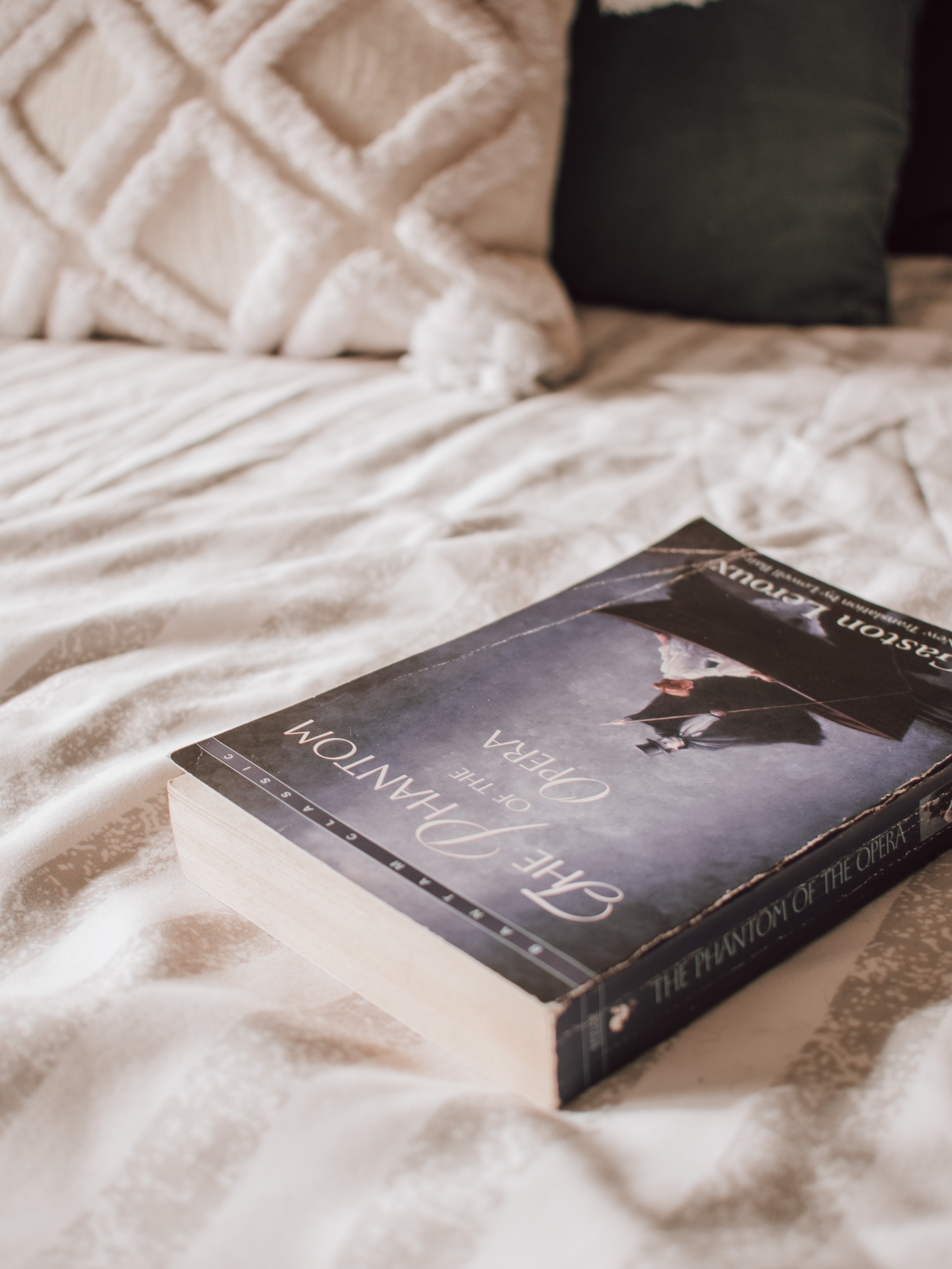

I don't remember how I ever picked up The Phantom of the Opera when I was 11. I had no reference for what the story was about before reading it. I hadn't seen the musical. I hadn't heard of it mentioned in any way. I just have a vague memory of seeing the cover and being intrigued by the idea of a mysterious, masked figure and the setting of a theater in Paris.
I remember becoming fully immersed in this book and making it my new obsession. Even though it was initially intimidating to my younger self who hadn't read many long classics up to that point in my life, I was swept away and was able to understand and keep up with the plot easily. Of course, I had to watch the movie as soon as I finished, but was disappointed that it did not live up to the vivid images I had in my head as I was reading about the opera, the characters, and the haunting world of the Phantom.
I was worried that picking this book up again nearly 15 years after my first read through it would tarnish the original perfect experience I had with it. But I'm glad to say I feel like it enhanced it as all the feelings and memories I had came flooding back to me as I was reminded of certain scenes and plot points.
Something that I had forgot was how The Phantom of the Opera is written like a piece of investigative journalism. Gaston Leroux is convincing in the way he makes the events seem like they could have really happened with pieces of supposed interviews with witnesses, written accounts he claimed to have found, and other mixed media aspects that make the structure of this book feel ahead of its time. Especially as he weaves in some bits of real history in the story, such as the event with the chandelier and the lake beneath the opera. The truth feels muddled which adds to the overall mystery.
The atmosphere of the book is developed so well. Besides the investigative aspects, the whole mystery surrounding the Phantom and whether he really is a ghost haunting and cursing the opera, or if he is merely a brilliant man, is done in such a suspenseful way. Things are revealed at a good pace, making it hard to put the book down. Some of the tricks and lingering questions aren't even addressed until the very last pages, and I even found myself surprised at certain parts.
I will say that the character development is probably the weakest part of the story. I was so engrossed in the plot while I was reading that I could overlook how flat Raoul and Christine were at times. The Phantom is not a character we really get to know until the very end, and even then I found it hard to become especially endeared to him after everything he does throughout the novel. However, I don't think any of the characters were supposed to be incredibly likeable. I was able to root for them and accept them for how they were since they were little more than pawns to deliver the story.
It will always be hard not to be biased when I'm trying to review a favorite book of mine. But I absolutely loved reading this book for a second time! I'm so glad that it remains on my list of all time favorites, and overall, I just loved how fun this book is. It's clever, eerie, even funny at times and is a story that will always be a part of who I am as a person and a reader.
Rating: ★★★★★
"He had a heart that could have held the entire empire of the world; and, in the end, he had to content himself with a cellar." -- Gaston Leroux, The Phantom of the Opera

"I am no bird; and no net ensnares me: I am a free human being with an independent will."-- Charlotte Brontë, Jane Eyre

Watership Down follows a small group of wild rabbits who become refugees, leaving their old warren which is set to be destroyed by construction work. They go on an incredible journey to find a new home. The book shows their struggles to survive as they create a new community for themselves. The story is full of rich language, amazing characterization, and darker themes which work to make the world of rabbits reflect our own society at times.
My earliest memory of Watership Down is of my dad reading the first chapters out loud to me when I was between the age of five and six years old. Looking back, I was far too young to fully understand the complexity of this story at the time, but that early exposure made me curious about the rest of the book. I'm grateful for those memories because they led me to pick up the book again when I was a little older.
Watership Down was Richard Adam's first book that he ever wrote or published, and that fact alone astounds me. The writing is so rich. It's full of emotion and atmosphere. It's a warm blanket that envelopes the reader through the whole reading experience.
Since the rabbits don't understand human things, such as cars, trains, and notice boards, there are so many amazing examples in the writing of showing the readers what the Rabbits see or experience, without explicitly explaining what it is to the reader.
Along with the beautiful writing, the pacing of the plot is nearly perfect. All the events are executed extremely well, with foreshadowing peppered in that you don't notice until you've read the book multiple times to catch on to what's happening.
"All the world will be your enemy, Prince with a Thousand Enemies, and whenever they catch you, they will kill you. But first they must catch you, digger, listener, runner, prince with the swift warning. Be cunning and full of tricks and your people shall never be destroyed." -- Richard Adams, Watership DownIt would be a bit of a stretch to call this book a fantasy novel, but the world in which these rabbits live in is so vividly crafted by Adams. This society of rabbits has its own language, social classes, and a mythology that work to make this story that much more real to the reader.
Some of my favorite chapters in this book are those with the rabbit folklore stories that are scattered throughout. The tales of Frith, the god figure, and El-ahrairah, the clever mythical rabbit prince, read like fairytales and are so lovely to read in the midst of suspenseful scenes of conflict.
The plot, while incredible, is propelled by the strong characters in this story. Despite the fact that the characters are all rabbits, Richard Adams brings them all to life. One of my favorite things in a book is when relationships between characters are strong, and the loyal relationships between Fiver, Hazel, Bigwig, and the other rabbits in this book are so touching. Their struggles and friendships are relatable. The reader becomes attached to the characters so gradually that you don't realize how much you care until the climax.
Now that I'm in my twenties, I have read through this beautiful story three times from cover to cover and it has secured a solid place on my All Time Favorites bookshelf. I think about it all the time. Whenever I see it I itch to pick it up again, and when I finish a reread, I am always sad that it's over. I have found new things in this book every time I've read it. No review can do justice to the feelings I have for this book. It's so special to me, and I don't think I'll ever tire of it. If I had to read one book for the rest of my life, it would be this one.
Rating: ★★★★★
"There is nothing that cuts you down to size like coming to some strange and marvelous place where no one even stops to notice that you stare about you." --Richard Adams, Watership Down

 It's been so long since I have read a book that blew me away. That left me wounded and raw, yet full hearted and hopeful. That gave me perspective and revealed parts of myself that I didn't even know existed. That captured me so completely. I almost thought no book ever would touch my heart quite like that again, until I read A Tree Grows in Brooklyn.
Under any normal circumstances, A Tree Grows in Brooklyn is not the type of story I would've expected to like that much. It's a coming of age story following an eleven-year-old girl, Francie Nolan, and her family in early twentieth-century Brooklyn. I expected a light feel-good story. Enjoyable, but nothing profound. There was no way I could have predicted how much this book would impact me when I started to read it.
A Tree Grows in Brooklyn is the type of book that changes your life.
It's the type of book that settles in your soul without you realizing it. It speaks softly and slowly. It shows the difficulties of life, like death, starvation, and the pain of growing up too fast in a gentle way. It doesn't brush over hard topics or look at them through nostalgic, rose-colored glasses. The author, Betty Smith, writes with brutal truthfulness and doesn't hold back. But she is able to deal with it all with a beautiful childlike wonder and respect so it's not a burdensome task to read.

 |
| | goodreads | ★★★ |
I had heard countless mixed things about it. People usually either love it and find it a powerful piece of literature, while others absolutely hate it. I didn't know where exactly I would rank on the love/hate scale.
I was actually surprised at how much I actually liked this book when I finally did end up reading it.
I think I decided to read it during the perfect time in my life. I was just feeling upset and frustrated with everything and everyone at the time I first picked this book up, and I instantly found a kindred spirit in the crazy, cynical Holden Caulfield... I'm not sure if that's a good thing or not...
He tells it how it is, and doesn't sugar coat anything in his narrative. If he thinks that someone is an idiot, he'll tell you exactly why. I actually found myself laughing out loud at some of the things Holden says, which doesn't happen often when I'm reading. His voice is refreshing, and I just couldn't hate him, despite the fact that he can be quite a jerk at times.
The Catcher in the Rye is a short read, but nothing really happens in it... there is only the faintest glimmer of a plot or story. It is mostly just Holden's stream of consciousness as he stalls in New York. It is fun and entertaining at first, reading all of his thoughts on everything that's going on, but after awhile, it all sounds the same and his cynicism gets kind of old.
I'm not one to criticize a notable, famous author, but I feel like this whole narrative could've been condensed into a short story or something. Even at 250 pages, it felt long and a bit dragged out at times.
I feel like I'm somewhere in the middle with The Catcher in the Rye. I don't really love it or hate it exactly.
I can definitely see how this book is considered a classic. Holden makes you think in between his whining and complaining. There are some very thought provoking themes on childhood and growing up that he brings up, which is all interesting.
While I probably won't necessarily read it again, I'm very glad I did.
I think that everyone should at least give this book a chance and take what they can from it.
“I'd just be the catcher in the rye and all. I know it's crazy, but that's the only thing I'd really like to be. I know it's crazy.”
― J.D. Salinger, The Catcher in the Rye

 |
| | goodreads | ★★★★★ |
This story follows the main character as she spontaneously finds herself becoming the second Mrs. De Winter, her experiences as she uncovers the dark secrets of her new husband's past, and the presence of his first wife, who continues to haunt them beyond the grave.
I was nervous when I started this book. So many other readers and reviewers who I greatly respect have sung the many praises of this book. Like every hyped-up book I read, I was afraid that I would get my hopes up too high and become extremely disappointed if it didn't live up to them. However, I'm very pleased to say that Rebecca most definitely lived up to every bit of the hype and then some.
I was also afraid this was going to turn out to be a ghost story. I have a hard time enjoying scary types of books, but this book surprised me. It turned out to be more of a mystery thriller than a creepy ghost story. From the moment you meet Maximilian De Winter, you're trying to piece together what truly happened to Rebecca.
I really liked the fact that the main character, the second Mrs. De Winter, remained anonymous throughout the whole book. The narration was told in her point of view, and since you never find out her real name or who she really is, it makes you feel like you are her as you're reading. You relate with her and feel what she feels as you're figuring out the mystery of Manderley with her.
The other characters were intriguing as well. You never know exactly who to trust or who to like. Some of my favorite scenes were those with Mrs. Danvers, she was shady and untrustworthy, but she was passionate. When she would get angry I could practically see her going on her tirades. Frank and Bee were some of my other favorites.
The pacing of the book was nice. Daphne Du Maurier's writing is so fluid and smooth, you don't care at all if the story goes slowly or not. However, once the ending hits and secrets start slipping out, the plot quickly becomes a speeding rollercoaster of crazy emotions. There were many plot twists I didn't even see coming, and I'm usually shockingly good at guessing plot twists.
This was truly a curl-up-with-a-cup-of-tea-and-a-mountain-of-pillows-on-a-rainy-day kind of read. It's suspenseful, and moody, and dark, and Daphne Du Maurier's descriptions of Manderley are drop dead gorgeous! It's a beautiful gothic novel that I will most definitely be picking this one up again someday soon.
I suppose sooner or later in the life of everyone comes a moment of trial. We all of us have our particular devil who rides us and torments us, and we must give battle in the end. --Daphne Du Maurier


Social Icons